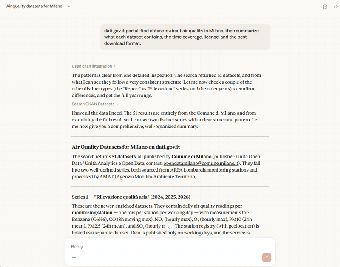
Bridge between LLMs and CKAN portals for metadata discovery
Ckan Mcp Server, developed by Ondata, connects large language models to CKAN-based data portals to enable natural-language dataset discovery and metadata retrieval. The server exposes keyword search, package metadata and resource listing through the Model Context Protocol, letting AI clients query CKAN instances without manual API calls. It supports configuration via environment variables or files, and targets data scientists, researchers, and developers who need AI-assisted access to public open-data catalogs.
What tasks the server actually performs for AI workflows
The server acts as a protocol adapter that lets an AI client discover and fetch CKAN metadata, so users can ask an assistant to locate datasets or inspect package details. It maps MCP requests to CKAN Action API calls, producing structured responses the model can consume. This design turns conversational prompts into concrete data-portal queries, removing the need to write action-API requests manually when an MCP-capable client is in use.
How reliable the retrieved metadata is in practice
Reliability depends on the source CKAN instance and its metadata quality, because the server forwards portal search and package responses rather than enhancing them. MCP compliance ensures consistent message structure between client and server, but accuracy of descriptions, tags, and resource links mirrors what each portal publishes. Users should treat returned metadata as a pointer to source records and verify dataset contents on the originating portal when precision matters.
What inputs, deployment steps, and limits to expect
Deployment requires a host that supports the Model Context Protocol and a Node.js runtime, since the server is written in TypeScript and runs locally or on a networked host. Configuration uses environment variables or configuration files to set the base URL of a CKAN instance and optional API keys, so private portals requiring authentication can be addressed. The server does not alter CKAN access control; restricted endpoints remain subject to the portal's permissions.
How the tool fits into existing AI and data workflows
Pointing the open-source server at a portal integrates CKAN catalogs directly into MCP-enabled assistants, which makes it useful for research inquiries and rapid dataset discovery. Compatibility with common MCP clients, notably Claude Desktop, positions it for environments that already use that protocol. Because it supports local deployment, organizations can host the bridge inside their infrastructure and align it with internal data governance policies.
Practical bridge for AI-assisted open-data discovery with deployment caveats
The server is a pragmatic option for data teams and developers who need AI clients to query CKAN portals, since it implements MCP and uses the CKAN Action API. Expect catalogue-dependent accuracy and a setup that requires Node.js and an MCP host. For projects that can host an adapter locally and rely on portal metadata, the server meaningfully shortens the path from natural-language query to dataset record.
Pros
Implements Model Context Protocol for direct MCP client integration
Uses CKAN Action API for native compatibility with standard portals
Configurable via environment variables or configuration files
Open-source, runnable locally with Node.js and TypeScript codebase
Cons
Returned metadata accuracy depends on source CKAN portals
Requires an MCP host environment such as Claude Desktop to connect AI clients
Setup requires Node.js and basic configuration knowledge
Restricted CKAN endpoints still need portal API keys or permissions
Laws concerning the use of this software vary from country to country. We do not encourage or condone the use of this program if it is in violation of these laws. Softonic may receive a referral fee if you click or buy any of the products featured here.